Draa Valley Hiking & Trekking Guide

A 200-km caravan corridor of palm oases to the Sahara
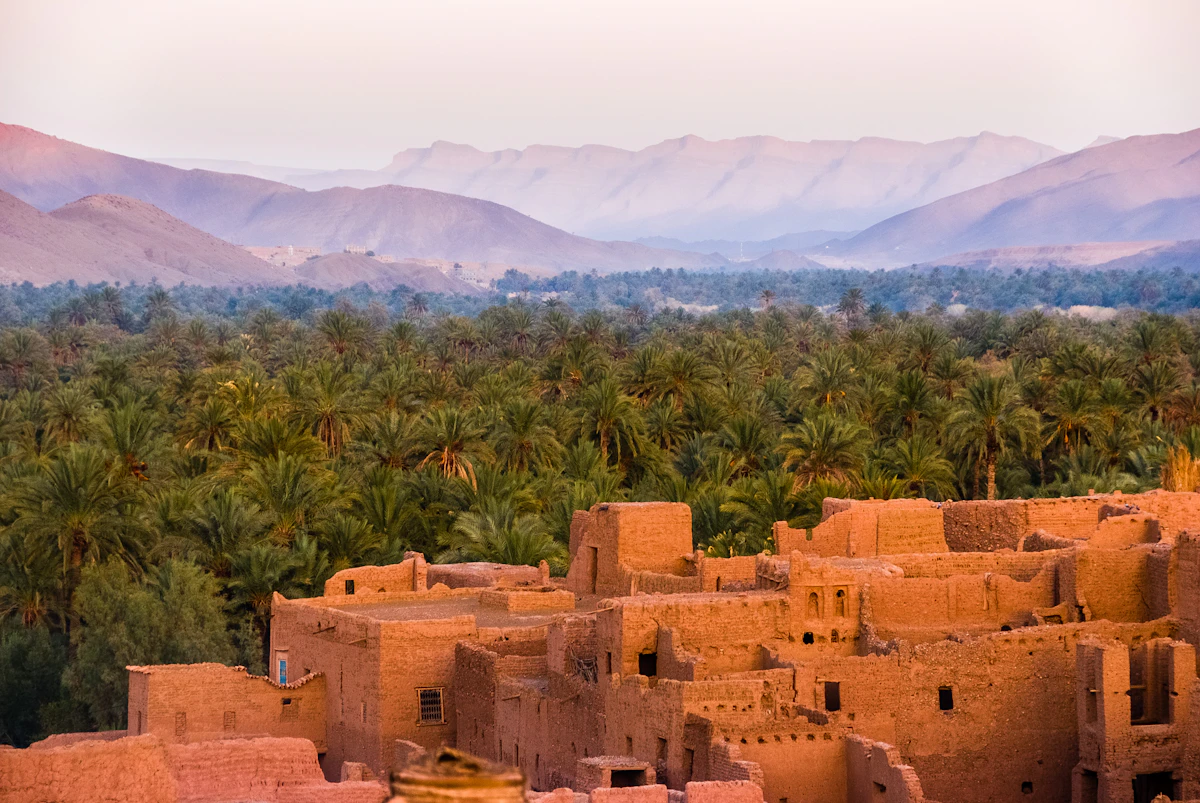
The Draa is one of the great caravan routes of the Sahara world — a 200-km corridor of date-palm oases, ancient earthen ksour and Amazigh communities who traded across the desert for centuries. Walking the valley’s length culminates in a night in the dunes near M’hamid on the edge of the Sahara, where the oasis gives way to open sand.
Region: South Morocco / pre-Saharan · Altitude: 1,000–1,100 m
History
The Draa valley hosted a succession of Amazigh, Arab and sub-Saharan cultures linked by the trans-Saharan trade in salt, gold and slaves. The 17th-century manuscript library of Tamegroute, the ksar citadels built in earthen pisé, and the nomadic Rguibat communities all carry the valley’s caravan past into the present.
Culture
A layered mosaic of Amazigh, Arab and sub-Saharan cultures — ksar citadels in earthen pisé, the historic Tamegroute library, and the nomadic Rguibat and M’hamid communities of the pre-desert. At desert camps, Gnaoua and Berber music around the fire is a genuine tradition, not a show.
Climate
Warm sunny days and cool nights from October to April; the almond blossom in February is spectacular. Summer heat (40 °C+) makes the valley impassable on foot, so we do not trek then.
Best time to visit
October to April — warm days, cool nights and clear skies. February brings the extraordinary almond blossom across the oases.
Food
Southern Moroccan cooking: date-sweetened tagines, fresh bread from clay ovens, medjool dates and salads of local vegetables, with camel-milk tea with nomads in season. Vegetarian and dietary needs catered for.
Geography
The Draa river flows from the Central Atlas southward through a 200-km corridor of palm oases and earthen ksour to the pre-desert near M’hamid, where the valley ends at the edge of the Sahara. The walking is on flat palmery paths and desert pistes at around 1,000 m.
Hiking opportunities
Trekking the valley walks the palm-oasis corridor, visits the ancient ksar library at Tamegroute and finishes with a night in a desert bivouac near M’hamid. A camel carries the supplies so the pack is light; the distance, not the terrain, is the challenge.
Getting there
A private vehicle and driver cover the full journey, crossing the Tizi n’Tichka or Tizi n’Test and following the valley route. A camel team supports the walking stages in the oases and dunes.
Accommodation
A mix of local riad, village guesthouse and a desert bivouac camp near M’hamid — simple, genuine and increasingly remote as you approach the Sahara. Bedding, meals and blankets are provided at each stop.
Safety
A certified guide and experienced driver lead throughout, with the desert section using a camel team for carrying and navigation. Emergency communication and a first-aid kit are always carried; heat requires early starts and midday shade breaks.
Difficulty & fitness requirements
Tours to Draa Valley range in difficulty: Moderate. Choose a trek that matches your fitness and experience, and ask our guides for a personalised recommendation.
Altitude: 1,000–1,100 m. Higher destinations demand better acclimatisation and fitness; our itineraries build in gradual ascent where needed.
Villages
- Agdz
- Zagora
- Tamegroute
- M’hamid
Frequently asked questions
Is the Draa Valley the same as the Sahara?
The Draa runs along the southern edge of the Atlas and ends near the Sahara at M’hamid. The valley itself is lush oasis; only the final section approaches open desert dunes.
When is the almond blossom?
February, when the Draa oases turn white and pink with almond blossom — one of Morocco’s great natural spectacles and a beautiful time to walk the valley.
Photos